

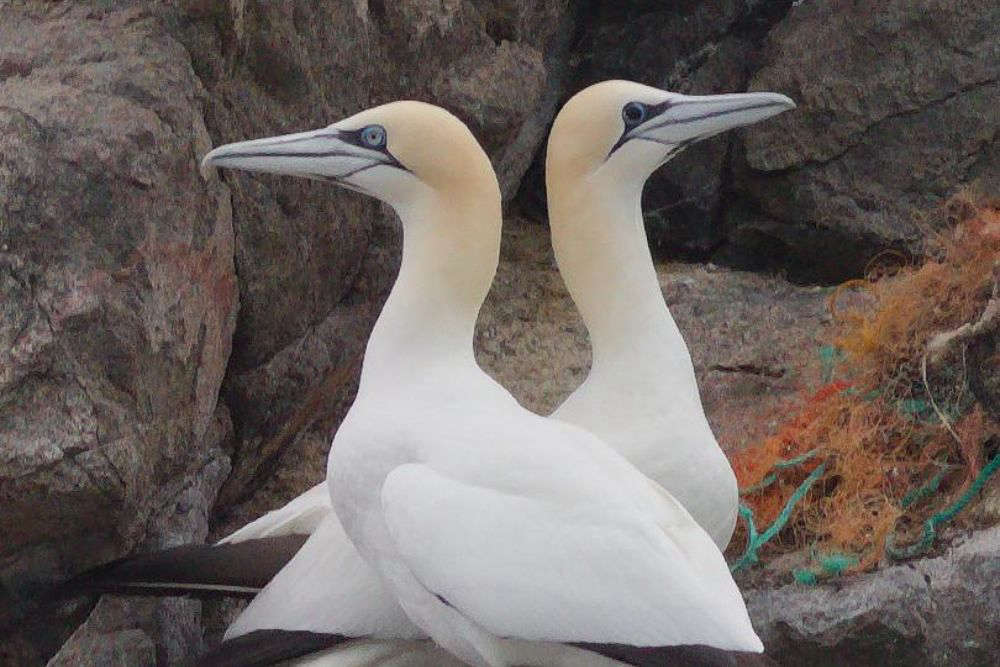
The Alderney Wildlife Trust says there are spaces lower down on the rocks where they live, showing the heavy price paid by gannets for getting avian flu.
Somewhere between 1% and 1.5% of the world's population of gannets live on Les Etacs and Ortac off Alderney. The rocks are right at the southern edge of where the species can survive and breed.
The Alderney Wildlife Trust's RAMSAR officer, Alex Purdie, says the effect of avian flu is apparent:
"We're looking at an estimated decline of possibly as much as 30%, which is significant. But Alderney's colony got away with it compared to other colonies. In the UK there was a much higher mortality. We also have a reduction in prey availability, driven by climate change."
However, Alex says there's evidence that gannets are developing an immunity and have an unusual, tell tale sign:
"The black eye phenomena. Gannets usually have a startling bright eye. But in infected birds, their iris has turned completely black, so you can't see the pupil in it. This has been caused by inflammation, relating to the influenza infection."
Alex says it's a positive sign:
"We're in a hopeful period. We're seeing this high proportion with the black eye, so there's some hope there might be a bit of immunity. And just now is the time we're starting to see our first few gannet chicks."
 Work on Guernsey's Victor Hugo Centre may begin by Easter '27
 Channel Islands mobile portability issues to be resolved soon
 Channel Islanders in the Middle East told to follow local warnings
 Freehold of Guernsey's Premier Inn for sale
 Unprecedented demand for cesspit emptying in Guernsey
 Food will not be exempt from GST in Guernsey
 Victor Hugo Centre fund reaches £7.5M
 "We want our schools to be smartphone-free environments"