

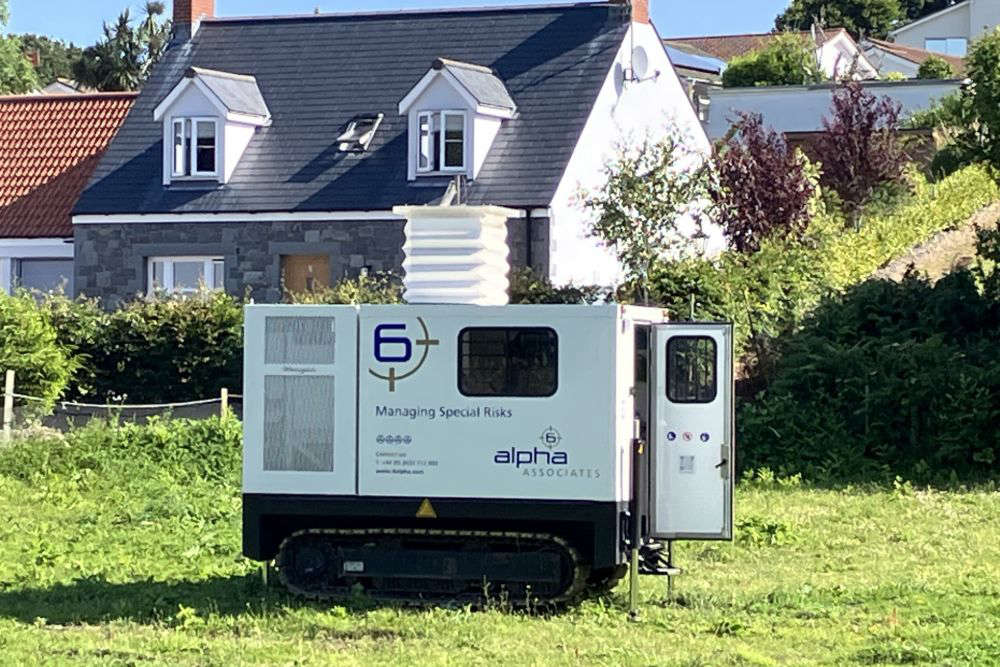
Specialist government contractor to risk assess four metallic devices buried deep under a paddock near the Foulon cemetery.
Home Affairs, the States department responsible, says it is committed to continuing the work on the powerful warheads and keeping people living nearby updated of progress.
The bombs fell in March 1941 and this summer a specialist vehicle was used to carry out a below ground survey to determine, beyond doubt, if they were there.
Four metallic 'blips' were discovered and now Home Affairs has signed an agreement with a UK government contractor, Defence Science and
Technical Laboratory, (DSTL) to look at the data and assess the risk posed.
Deputy Marc Leadbeater who leads Home Affairs says the bombs are a priority, despite calls from local mines expert Ben Remfrey to speed up the analysis:
"Public safety is of course a priority for the Committee, and that is why we have continued to ensure this work progresses; however, we have also ensured this is being done in a proportionate and cost-effective way.
"We did consider using a private contractor, but that would have cost the taxpayer a five-figure sum and only brought the work forward by a few weeks at most, so the cost could not be justified."
The assessment is expected to take a month or so and a report should be ready by December, according to the States official in charge.
 GST backlash prompts call for calm from Guernsey deputy
 Deputies vote in GST at 3% as part of tax reform package
 Man charged with murder of Hannah Benfield in Alderney
 Deputy Inder apologises for raising middle finger to GST protestors
 Guernsey employers face delay over work permits
 Chris Kamara launches men's mental health initiative in Guernsey
 Alderney murder investigation stretching Guernsey Police resources