

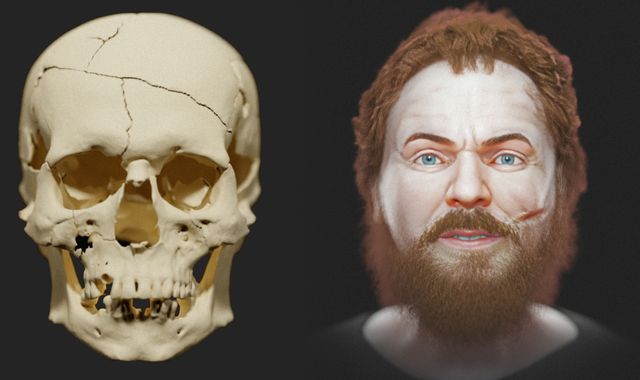
The face of a "vampire" whose remains were posthumously mutilated to prevent them rising from the dead can be seen for the first time in more than 400 years.
Discovered in a grave at Racesa, a fortress in eastern Croatia, the body had been exhumed, beheaded and reburied face down beneath heavy stones.
And since the desecration cannot be explained by environmental factors, experts believe it was done to stop the dead man returning as a vampire.
Now the face of the deceased can be seen for the first time in centuries, after scientists rebuilt his likeness from his skull.
Archaeologist Natasa Sarkic, part of the excavation team, said the fear inspired by the man in death may stem from the fear he inspired in life.
She said: "Bioarchaeological analysis showed that this man often participated in violent conflicts, and died a violent death.
"He experienced at least three episodes of serious interpersonal violence during his lifetime.
"One of those attacks left his face disfigured, which could cause fear and repulsion, leading to social exclusion.
"Before even recovering from the penultimate trauma, he sustained a final fatal attack."
She continued: "Individuals who died violently, behaved violently in life, or were considered sinful or socially deviant, were believed to be at risk of becoming vampires.
"He may have been regarded as a 'vampire', or a supernatural threat due to his facial disfigurement and his marginal lifestyle, characterised by repeated interpersonal violence.
"Such beings were thought to be restless, vengeful, and capable of harming the living, spreading disease and killing people or livestock."
Dr Sarkic said that, in the Slavic tradition, the soul remains attached to the body for about 40 days after death.
In this time, various preventative measures could be used to prevent the dead from returning as vampires.
These included staking, burning or beheading the corpse, burying it face down, weighing it down with stones and binding the limbs.
This burial therefore showed "practices commonly associated with 'anti-vampire' rituals at the time", Dr Sarkic said.
To complete the reconstruction, graphics expert Cicero Moraes started by virtually rebuilding the man's skull using data from a CT scan.
"Although the skull was somewhat fragmented at the time of its discovery, it was possible to reconstruct and digitise it," Dr Sarkic said.
More data from living donors was then used to plot the likely placement of facial features, and the thickness of soft tissue in different places across the skull.
A technique called anatomical deformation was also used, whereby a donor's head is virtually adjusted until it matches the subject's skull, revealing a potential face.
Combining these approaches revealed an objective face, based solely on the shape of the skull, without subjective features like hair or skin tone.
A second version of the face is more artistic, introducing some of these speculative elements for a more life-like recreation.
Mr Moraes said it was a "hostile, threatening" likeness.
"The facial scar and other injuries obtained during his life are quite a significant sign that his life may have been rather turbulent," he said.
The Racesa "vampire" lived in the 15th or 16th century, was roughly 5ft 4in tall, and is believed to have died between the ages of 40 and 50.
Given his injuries, he may have been a soldier, or simply a person accustomed to violent encounters.
He was buried inside what seems to have been a church, though his grave was in the "the most disfavoured spot" along the wall.
And it seems his head was literally pulled from his body, since there are no cut marks consistent with decapitation on his neck, skull and shoulders.
His grave was discovered in 2023 and is one of more than 180 burials found in the fortress, which stood 70 miles southeast of Zagreb.
Further examples of vampire belief can be found elsewhere in Europe, including more desecrated graves in Poland.
In Serbia, meanwhile, the body of Petar Blagojevic was staked through the heart, and burnt as a suspected vampire after his death in 1725.
While Jure Grando Alilovic, a Croatian villager who died in 1656, is described as a vampire in historical records.
Read more:
Face of 'most important' 8,500-year-old American revealed
Face of 75,000-year-old Neanderthal woman reconstructed
Racesa itself is believed to have been occupied first by the Templars, then the Knights Hospitaller, and finally by the local nobility.
Mr Moraes, Dr Sarkic and their co-authors published their study in the journal OrtogOnLineMag.

(c) Sky News 2026: Face of a 'vampire' revealed: Science rebuilds likeness of man decapitated after d
 Starmer battling for survival after his chief of staff resigns
 Briton Jimmy Lai sentenced to 20 years after national security conviction in Hong Kong
 'China is watching': Election victory for Japan's PM Sanae Takaichi could threaten stability of region
 Social media goes on trial in LA - here's what you need to know