

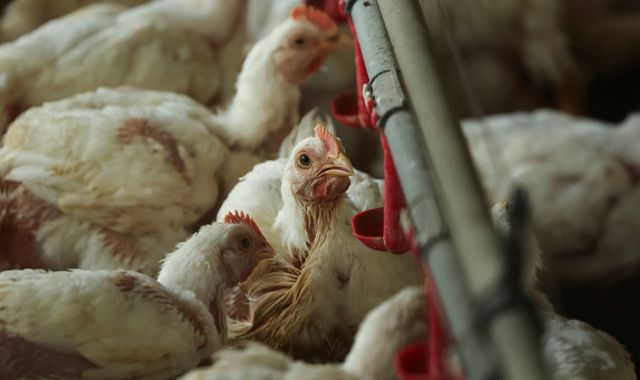
Industrial poultry farming has led to a more than 100-fold increase in the spread of a bacteria causing food poisoning, scientists have discovered.
Campylobacter is the most common bacterial cause of diarrhoea worldwide, resulting in 3.5 times as many upset stomach cases in the UK each year as all other monitored foodborne bacteria.
The huge global expansion of chicken farming over recent decades has created ideal conditions for the bacterium to spread and adopt new tactics to survive, a study by Ineos Oxford Institute researchers at the University of Oxford found.
The scientists said the rapid expansion of global chicken numbers, increasing seven-fold to about 31 billion birds since the 1960s, had allowed bacteria from wild birds to circulate in the poultry population.
Researchers analysed nearly 2,800 bacterial genomes collected from chickens and wild birds in 30 countries, including the UK and USA, between 1979 and 2024.
Using genomic analyses, the researchers identified genetic changes in campylobacter that were associated with changes to their environment.
These included genes involved in antimicrobial resistance, which occurs when bacteria resist drugs designed to kill them, and traits that can help bacteria survive in modern poultry farming systems.
The rising rates of antimicrobial resistance are also making campylobacter infections increasingly difficult to treat, they said.
Mathematical modelling from the study showed that once chicken numbers reach a large scale, strains of the bacteria that originated in wild birds can become self-sustaining within poultry populations.
Sam Sheppard, professor of microbial genomics and evolution at the University of Oxford and senior author of the paper, said: "Our findings provide new evidence that human-driven environmental change can increase the spread of infectious diseases.
"Understanding these evolutionary consequences is essential if we are to reduce future risks from zoonotic disease and antimicrobial resistance."
Read more from Sky News:
UK's largest telescope faces closure
Tate brothers to remain in jail
The study also found that large, densely populated chicken flocks may act as ecological "pathogen sponges", meaning that they absorb and amplify bacterial strains from multiple sources.
Oakem Kyne, a researcher at the University of Oxford and first author of the paper, said: "As campylobacter strains adapt to life in poultry, they can acquire traits that help them survive in challenging environments, including traits linked to antimicrobial resistance.
"Understanding how farming practices influence bacterial evolution is an important step towards reducing the burden of foodborne disease."
Chickens now account for around 70% of all bird biomass on earth, the researchers said.
A previous Ineos Oxford Institute study found that 80% of human campylobacter infections in Oxfordshire were associated with poultry meat, with many being resistant to antibiotics.

(c) Sky News 2026: Industrial poultry farming leads to 100-fold increase in food-poisoning bacteria, study finds
 British woman killed in Florida was 'gentlest soul', family says, after man arrested for murder
 Carly Simon reveals Parkinson's disease diagnosis
 Seattle food festival shooting involved three suspects, including 15-year-old, police say
 Armed officers to patrol UK's largest Pride event amid heightened safety fears